
USDT TRC20 vs BEP20: fees, confirmation times and wallet support
Compare USDT TRC20 vs BEP20 for merchant checkout: forwarding fees, minimum deposits, confirmation times, wallet checks and which network to offer first.
Published , updated

USDT TRC20 vs BEP20 is a checkout decision about the network your buyers can actually use and the cost of forwarding each deposit. Start with BEP20 when small orders and lower configured forwarding charges matter most. Start with TRC20 when your buyers already hold USDT on TRON. Offer both when you can explain the network choice clearly and support each payout destination.
A cheaper route is no help to a buyer whose funds are on another network. Before choosing, ask a few real customers where they keep USDT and which withdrawal networks their wallet or exchange offers. That answer should carry more weight than a headline transaction speed.
USDT TRC20 vs BEP20: what changes at checkout?
The token name alone doesn’t identify a payment route. In Suawave, trc20/usdt selects USDT on TRON and bep20/usdt selects USDT on BNB Smart Chain. Each route needs its own compatible payout address. Ethereum mainnet is not enabled yet, so don’t present ERC20 as an available Suawave checkout option.
| Decision | TRC20 USDT | BEP20 USDT |
|---|---|---|
| API ticker | trc20/usdt |
bep20/usdt |
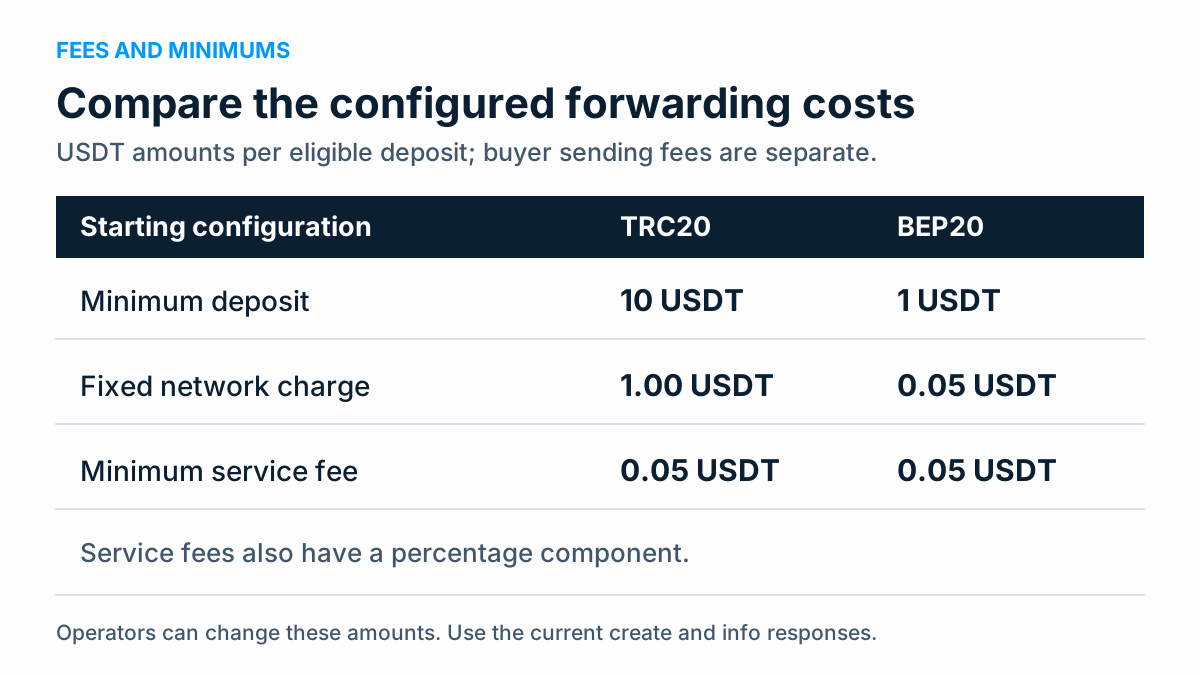
| Shipped mainnet minimum deposit | 10.00 USDT | 1.00 USDT |
| Shipped fixed forwarding network charge | 1.00 USDT | 0.05 USDT |
| Shipped minimum service fee | 0.05 USDT | 0.05 USDT |
| Chain finality policy | Solidified blocks | Provider’s finalized block tag |
| QR with an amount | Address only | EIP-681 transfer request |
Those amounts describe the repository’s starting configuration, not a permanent quote. Operators can change the schedule. Read minimum_transaction_coin from info or create, inspect the created address’s fee fields, and use confirmed callback values for the actual deduction. The fees and minimums guide is the reference for that calculation.
Keep each network choice attached to the stored order. Changing a label in the browser mustn’t leave the server expecting a payment on the previous ticker.
Which USDT network has lower merchant fees?
Under the shipped fixed network charges, BEP20 has a 0.95 USDT advantage per forwarding transaction over TRC20. That difference matters more on a 10 USDT sale than on a 500 USDT sale. It also grows when a buyer pays one order in several eligible deposits, because each deposit is forwarded and charged separately.
There are two different expenses to explain. The buyer’s wallet or exchange charges for sending the inbound payment. Suawave then deducts service and network fees when forwarding the deposit to your payout address. A withdrawal fee shown by an exchange isn’t the gateway’s forwarding charge. Don’t put the two into a single unlabeled “network fee” line.
The service fee has a percentage component and a minimum. Its amount is rounded up to the asset’s smallest unit. Avoid copying a percentage into checkout copy that will outlive the current schedule. Link the current fees page and store the values relevant to your integration.
Does the buyer need TRX or BNB?
For a self-managed wallet, the transaction needs the sending network’s resources or native gas. TRON uses TRX and its resource model; BNB Smart Chain uses BNB for gas. An exchange withdrawal interface may charge the customer differently. Test the actual sending flow your customers use instead of assuming that holding enough USDT is sufficient to send it.
Suawave’s GET /{ticker}/estimate/ has a different purpose. It returns a configured forwarding cost ceiling in the native coin, such as TRX or BNB. It isn’t a live quote of the USDT deducted from a deposit. For TRON, that ceiling also doesn’t bound every separate preparatory resource cost. Don’t convert it into a promised customer fee.
Should the order use gross or net USDT?
Make that decision before writing your callback handler. value_coin is the inbound amount. fee_coin is everything charged, and value_forwarded_coin is the net amount reaching the payout address. A shop selling an item for 25 USDT might accept a gross deposit of 25 USDT and absorb the fees. A different business might require a particular net receipt.
Both policies need exact arithmetic and clear customer instructions. A confirmed payment can be genuine and still fail your chosen amount rule. Our guide to crypto payment underpayments and overpayments shows how to keep those cases separate.
How long do TRC20 and BEP20 payments take to confirm?
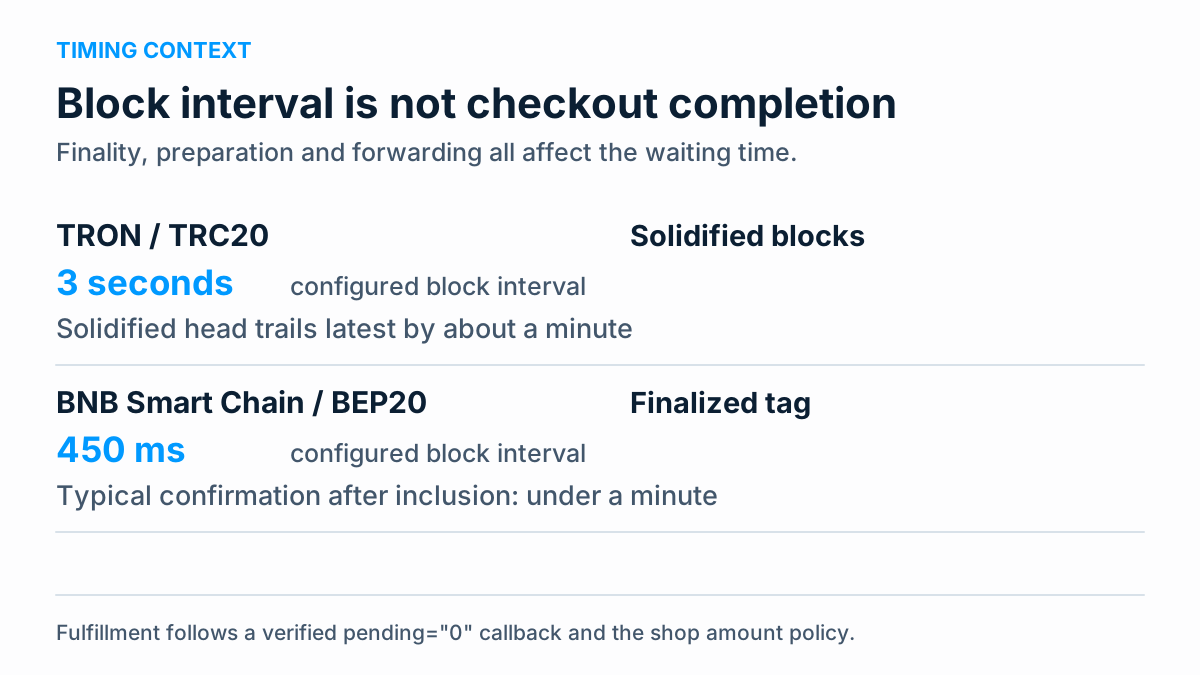
Suawave waits for chain finality, then completes forwarding. TRON deposits must be solidified. BNB Smart Chain uses finalized chain data; the ticker guide describes its typical confirmation time after inclusion as under a minute. Indexing, resource preparation and forwarding add time, so neither figure is a checkout completion guarantee.
TRON’s configured block interval is three seconds, but one block isn’t solidification. BNB Smart Chain’s registry interval is 450 milliseconds, but multiplying that by a small number doesn’t predict when your store receives its callback. See how crypto payment finality works for the difference between a recent block and a finalized payment.
With pending=1, a qualifying detected deposit can produce a pending callback. Use it to show “Payment detected, waiting for forwarding.” Don’t ship the order at that point. Suawave’s pending equal to "0" callback means the forwarding transaction has confirmed. Verify that event and its amount before marking the order paid.
A buyer may see a completed withdrawal before your shop sees a completed payment. Explain the waiting stage on the order page, and keep the page capable of showing a later status update. Repeatedly asking the buyer to send again creates a second payment problem.
Which wallets support TRC20 and BEP20 USDT?
Choose a wallet by the exact network and token it supports, not by whether its asset list contains “USDT.” Check that the payer can select the intended network, send the configured token and review the destination. Check the receiving wallet separately. An address accepted by an interface doesn’t prove that its owner monitors the intended network.
Suawave validates payout addresses for the selected ticker, but your checkout should still show the network beside the deposit address. A QR code shouldn’t be the only instruction.
For TRON, the QR payload is the plain deposit address even when you supply value. The buyer enters the amount in their wallet. For EVM tokens, supplying value produces an EIP-681 transfer request with the token contract, chain ID and amount in base units. Wallet support varies, and the payer may be able to change that amount. The API reference documents both formats.
What happens if someone selects the wrong network?
Don’t promise automatic recovery. Suawave only detects supported assets for the chosen network and order. Sending native TRX or BNB, or an unlisted token, doesn’t create the expected USDT callback or forwarding. The ticker guide explains the supported routes and the manual support path for unsupported transfers.
A useful checkout displays “USDT on TRON (TRC20)” or “USDT on BNB Smart Chain (BEP20)” immediately above the address. Keep that wording visible after copying the address. If you offer a network switch, generate and display the correct order details for the newly selected route.
Which network should a merchant offer first?
For a shop with low order values and buyers who can already send BEP20 USDT, I’d start with BEP20. Its shipped minimum and fixed forwarding charge leave more room for small purchases. For a shop whose customers already use TRON, I’d start with TRC20 and make the minimum obvious before payment.
Add the second route when customer demand justifies the extra checkout branch. Record network selection, abandoned checkouts and support requests without exposing complete callback URLs. Those URLs contain the secret used to retrieve an order’s logs.
Before publishing either route, walk through one real checkout: select the network, create the deposit address, scan the QR in the intended wallet, and inspect a verified confirmed callback. Check the gross and net values against your order policy. The USDT integration walkthrough covers address creation, and securing crypto payment webhooks covers the handler that turns that receipt into one paid order.