
Crypto payment finality on TRON, BNB Smart Chain and Ethereum
Understand crypto payment finality: TRON solidified blocks, BSC's finalized tag, Ethereum epochs and when a Suawave confirmed callback means you can fulfill.
Published , updated

Crypto payment finality is the point at which a payment’s block satisfies the network’s finality rule. A transaction appearing in a wallet or a recent block hasn’t necessarily reached that point. For a merchant using Suawave, there is another wait: the gateway must forward the eligible deposit and confirm that outgoing transaction before sending the confirmed callback.
That distinction explains a common support message: “My wallet says sent, but the shop still says waiting.” The buyer and the shop may be describing different stages of the same payment. A good checkout names those stages instead of showing a timer that promises an exact finish.
What does confirmed mean for a merchant?
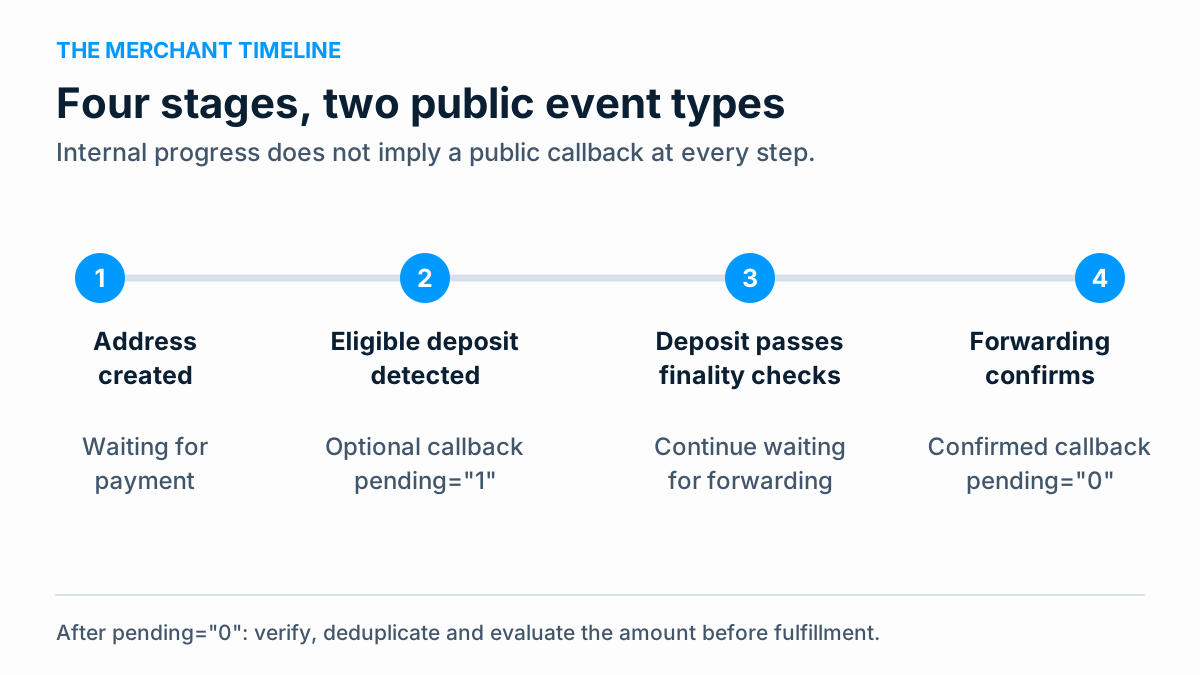
In Suawave’s public API, pending equal to "0" means the deposit has been forwarded and the forwarding transaction is confirmed. Verify the signature, match the deposit to the order, deduplicate the event and evaluate the amount. Only then should your application mark the order paid or schedule fulfillment.
With pending=1 at address creation, an eligible detected deposit can also produce an event with pending equal to "1". Detection comes from indexed chain data, not a separate mempool subscription. It is useful for showing progress, but it doesn’t authorize shipping.
| Stage | What it establishes | What the shop can show |
|---|---|---|
| Address created | A deposit destination is assigned | Waiting for payment |
| Eligible deposit detected | The indexer has seen a matching transfer | Payment detected |
| Deposit passes finality checks | The inbound evidence meets the chain policy | Continue waiting for forwarding |
| Forwarding confirms | The payout transaction is confirmed | Evaluate the confirmed callback |
The callback guide defines the public events. There isn’t a separate public callback for every internal stage in this table. Don’t invent an intermediate webhook your integration can’t receive.
Why does a gateway wait before crediting a payment?
Suppose a buyer sends 40 USDT. A node reports the transaction in block 1,000, and a block explorer displays it. If the network later replaces that recent block, the apparent payment may disappear from the canonical chain. Crediting solely from the first observation would turn provisional chain data into a merchant balance.
Finality checks narrow that gap. They also verify the transaction itself. A successful transaction hash isn’t enough to establish that the expected token moved to the expected destination in the expected amount.
Suawave’s EVM verifier checks the receipt against a canonical block header and the finalized head. It matches the token contract, transfer participants and integer amount, and rejects removed logs. The TRON path requires successful token execution and matching solidified receipt evidence. A transfer that doesn’t match stays outside the accepted payment path.
This is why a screenshot cannot replace a verified callback. It may show a different asset, a different destination or a transaction that hasn’t passed the gateway’s checks. Give support the transaction hash for investigation, but keep order updates tied to the actual payment evidence.
How does TRON solidification work?
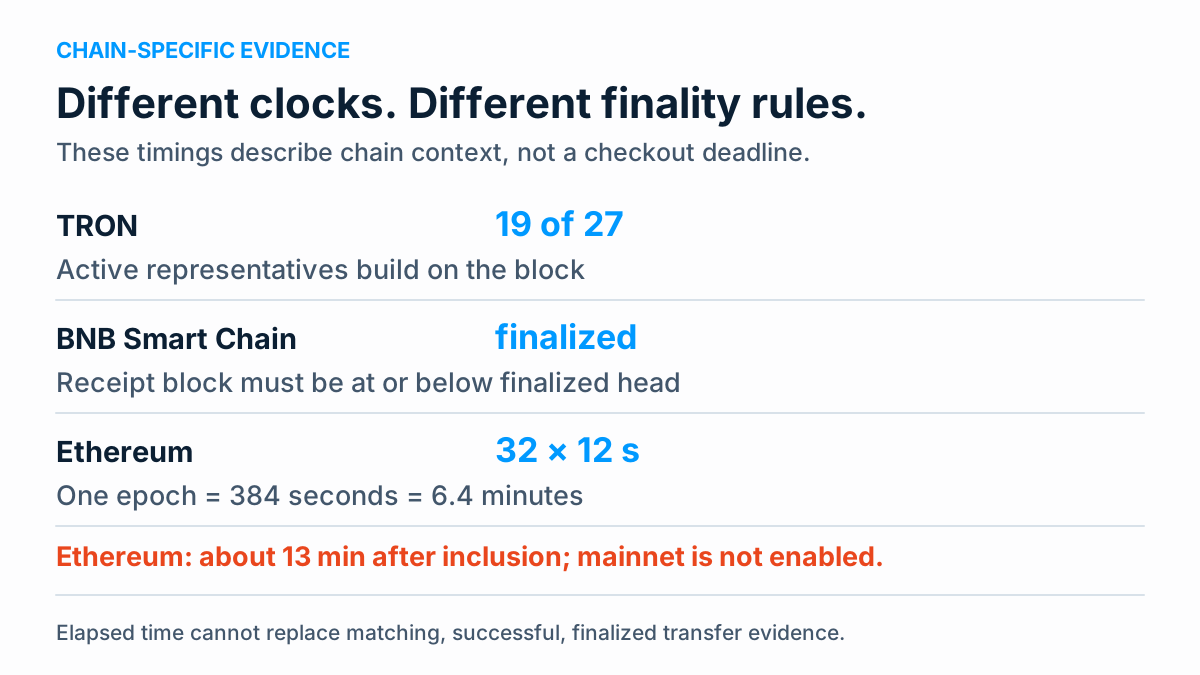
TRON separates the latest chain head from the solidified head. Its block producers are Super Representatives. A block becomes solidified when at least 19 of the 27 active representatives have built on it. The solidified head typically trails the latest head by about a minute, according to the TRON glossary.
Suawave’s TRON registry uses a three-second block interval and the solidified finality policy. Three seconds describes a block interval, not the time at which a merchant can treat a payment as final. Counting a few seconds from broadcast skips both inclusion and solidification.
The verifier reads solidity evidence. An absent solidity receipt leaves the deposit waiting, even if an earlier head sample appears high enough. Full-node inclusion alone doesn’t prove finality. That behavior is deliberate: the evidence must include the matching successful token transfer.
Is 19 confirmations the same as solidification?
No. The rule concerns distinct block producers building on a block. A generic confirmation counter doesn’t express that rule by itself. Suawave follows the solidified view rather than asking your store to translate an explorer’s number into a finality decision.
After the deposit passes that check, resource preparation and the outgoing USDT transfer still take time. If the checkout says “TRON blocks take three seconds, so payment completes in three seconds,” it sets the wrong expectation twice.
How does BNB Smart Chain use the finalized tag?
For BNB Smart Chain mainnet, Suawave’s registry selects finalized_tag, and the mainnet provider configuration enables finalized headers. The verifier needs a valid finalized head and checks that the receipt’s block is at or below it. It also checks that the receipt belongs to the canonical block.
The BNB Chain RPC documentation distinguishes latest, safe and finalized block tags. Those labels are different views of chain progress. Seeing a receipt at latest doesn’t mean it is already covered by finalized.
The repository configures a 450-millisecond BSC block interval. Its public ticker guide describes typical confirmation after inclusion as under a minute. Neither number includes every step of Suawave forwarding and callback delivery. Treat them as context for the waiting state, not a deadline for order fulfillment.
Can the merchant request fewer confirmations?
The public create endpoint doesn’t accept caller-selected confirmations. It also doesn’t offer a priority setting that buys a faster finality policy. Use the supported create parameters in the API reference; don’t add a guessed parameter copied from another gateway.
The callback’s confirmation count is useful information, but your order logic should follow the documented event semantics. A magic rule such as “ship at confirmation 12 on every network” throws away the differences the gateway already handles.
How do Ethereum epochs affect payment finality?
Ethereum mainnet is not enabled in Suawave yet. Its timing is included here to explain the architecture and help developers avoid carrying BSC assumptions into an Ethereum integration later. Ethereum Sepolia testnet availability doesn’t make Ethereum mainnet an available checkout route.
Ethereum divides time into 12-second slots and epochs of 32 slots, as described in the Ethereum proof-of-stake documentation. An epoch therefore spans 384 seconds, or 6.4 minutes. Validators vote on checkpoints; finality follows that consensus process rather than the appearance of one execution block.
Suawave’s ticker guide gives about 13 minutes as the typical Ethereum confirmation time after inclusion. That is an approximate expectation, not a timeout rule or a claim that every transfer finalizes after exactly two epochs. The disabled mainnet registry entry uses the finalized-tag policy, with a 32-slot epoch setting and a 12-second block interval.
Don’t convert those settings into a countdown that automatically marks an order paid. If finality takes longer, elapsed wall time supplies no substitute for finalized evidence.
What should checkout do while crypto payment finality is pending?
Keep a waiting page that survives a refresh. Store the selected ticker, deposit address and order state on the server. A pending callback can update the page to acknowledge detection, which often prevents an unnecessary second payment.
The browser’s return URL should only display server-side state. It shouldn’t mark the order paid because a wallet app returned focus, a QR was scanned or the customer pressed “I’ve paid.” The USDT checkout walkthrough covers the full address and callback flow.
Preserve forward progress when callbacks arrive out of order. A delayed pending callback mustn’t move a confirmed deposit back to waiting. Pending and confirmed callbacks have different UUIDs, while retries of one event retain its UUID. Our guide to securing crypto payment webhooks explains the database boundary that prevents repeated fulfillment.
How do you investigate a payment that is still waiting?
Start with the selected network and asset, then the assigned address and transaction hash. Check whether the transfer meets the ticker minimum. Confirm that it arrived within the order’s accepted time window. A below-minimum or late transfer can produce no public callback; waiting longer doesn’t change its eligibility. See underpayments and late crypto payments for those paths.
For eligible deposits, retrieve logs using the original callback URL. pending means forwarding hasn’t confirmed. sent means forwarding confirmed but the confirmed callback hasn’t been acknowledged, including exhausted retries. done means the confirmed callback was acknowledged. These states distinguish a payment delay from a delivery problem.
When comparing networks for checkout, compare the whole route your buyer and store use. USDT TRC20 vs BEP20 connects the finality policies to wallet behavior and per-deposit costs. For an unresolved order, keep the payment reference and verified evidence available to support, and leave fulfillment waiting until the amount policy is satisfied.